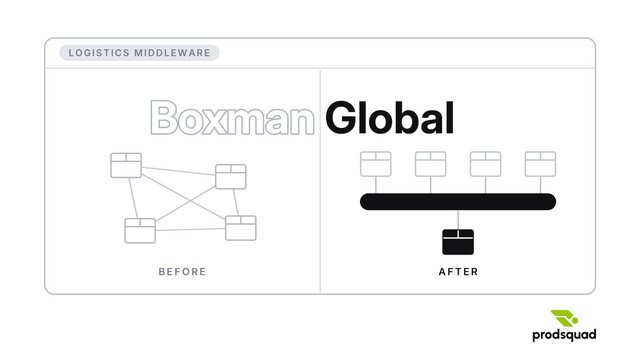
ProdSquad implemented logistics middleware and a supporting digital setup for Boxman Global, connecting its operational platforms into one integration layer. Shipment and order data now moves between systems automatically instead of being re-entered by hand, giving the team a single, current view of operations.
Client snapshot
| Client | Boxman Global |
|---|---|
| Industry | Logistics and supply chain |
| Partner | ProdSquad |
| Engagement scope | Logistics middleware implementation and digital setup |
| Deliverables | Systems and data mapping, a middleware integration layer between operational platforms, digital operations tooling, rollout and team handover |
What was the problem?
Boxman Global was running a logistics operation across systems that had been adopted at different times, for different reasons, and had never been designed to talk to each other. That is normal in logistics. It is also expensive.
- The same data entered more than once. Shipment, consignment and customer details were rekeyed between platforms by hand. Every repetition cost staff time and introduced a chance of error at exactly the point where errors are most costly to fix.
- No single source of truth. When two systems disagreed about the status of a shipment, resolving it meant a person checking both. Answering a straightforward customer question required opening several screens.
- Slow onboarding of new partners and carriers. Each new relationship meant another manual process, another spreadsheet, another set of instructions held in someone's head rather than in a system.
- Operational visibility that lagged reality. Management reporting was assembled after the fact from exports. By the time a picture was complete it described a position that had already moved.
- Process knowledge concentrated in individuals. The workarounds that kept everything running were understood by the people who built them. That is a continuity risk in any business and a serious one in an operation that runs every day.
None of this is a failure of the individual systems. Each one did its job. The gap was in the space between them, which is precisely the space nobody owns until someone is asked to.
Why ProdSquad?
Boxman Global needed a partner who could work at both ends of the problem: the technical work of making systems exchange data reliably, and the operational work of understanding what the business actually does with that data once it moves.
ProdSquad was selected because integration work of this kind fails when it is treated as a purely technical exercise. Mapping fields between two platforms is straightforward. Deciding which system is authoritative when they disagree, what happens when a record arrives incomplete, and who gets told when something fails, is where the value sits. Those are operational decisions that need a technical partner willing to sit in the operation and understand it first.
What did ProdSquad actually do?
Systems and data mapping
The engagement started with a full inventory of the platforms in use, the data each one held, and where the same information existed in more than one place. Every manual handoff was documented, along with what it cost in time and what happened when it went wrong. This produced the map the rest of the work was built against, and it is the step most often skipped.
The middleware layer
ProdSquad built an integration layer sitting between Boxman Global's operational platforms. Rather than forcing every system into a single monolithic replacement, the middleware translates between them: records created in one system appear in the others without a person retyping them, in an agreed format, with a defined system of record for each data type so conflicts resolve consistently rather than case by case.
Digital setup
Integration is only useful if people can see and act on what it produces. Alongside the middleware, ProdSquad delivered the supporting digital setup: the operational tooling and interfaces the team uses day to day, configured around the workflows that already existed rather than imposing new ones.
Rollout and handover
The layer was introduced in stages so the operation kept running throughout. Processes were documented as they were automated, which converted knowledge previously held by individuals into something the business owns.
What changed?
| Before | After |
|---|---|
| Shipment data rekeyed by hand between platforms | Data flows automatically through the integration layer |
| Systems disagree, and a person reconciles them | A defined system of record resolves conflicts consistently |
| Customer status questions need several screens | One current view answers the question |
| New partner onboarding built manually each time | A repeatable process with defined steps |
| Reporting assembled after the fact from exports | Operational data current and available as it happens |
| Workarounds understood by the people who built them | Processes documented and owned by the business |
What were the results?
Boxman Global now runs on connected systems rather than coordinated people.
- Manual re-entry largely removed. Staff time previously spent moving data between platforms returns to work that actually requires a person.
- Fewer errors at the handoff points. The places where data was most likely to be entered incorrectly are no longer places where data is entered at all.
- Faster answers to customers. Status information is current and available in one place, so enquiries are resolved during the call rather than after it.
- Partner and carrier onboarding is repeatable. Adding a relationship follows a defined process rather than being rebuilt each time.
- Management can see the operation as it is. Decisions are made against current data rather than a reconstruction of last week.
- Operational knowledge belongs to the company. The processes are documented and systematised, which reduces the risk carried by any one individual.
The broader effect is capacity. An operation that no longer spends its hours moving data between systems can absorb more volume without adding headcount in proportion, which is what makes growth economic rather than merely possible.
What is next
With the integration layer in place, the natural next steps are extending it to additional partners and platforms as the network grows, deepening the operational analytics the connected data now makes possible, and automating further exception handling so the team manages by exception rather than by inspection.
Frequently asked questions
What is logistics middleware?
Logistics middleware is an integration layer that sits between the separate systems a logistics business runs on and moves data between them automatically. It translates formats, decides which system is authoritative for each type of record, and removes the manual re-entry that otherwise connects platforms that were never designed to work together.
Why integrate the existing systems instead of replacing them with one platform?
Replacement is slower, more expensive and more disruptive, and it discards systems that individually work well. Integration keeps what the team already knows how to use, delivers value in weeks rather than quarters, and leaves the business free to replace any single component later without starting again.
How long does an implementation like this take?
It depends almost entirely on the number of systems, the quality of the data in them, and how many exceptions the business handles. Mapping is usually the longest phase, and time spent there is what keeps the build phase short.
Does the client need technical staff to run it?
No. The layer is built to run without intervention and is handed over with documentation and defined alerting, so the operations team works in the tools they already use and only needs to act when something genuinely requires a decision.
Does this work for a business that is still growing its system estate?
Yes, and that is usually the better time to do it. An integration layer built early means each new platform connects to one thing rather than to everything else, which is what keeps integration cost from compounding as the business adds systems.